Sunday, 20 November 2011

Raising Their Temple

Band: REX MUNDI
Release: 'IHVH' (2011)

As an arena of expression, extreme music has always walked the fine line between genuine artistic merit and a ridiculed circus of often unaware self-abasement. In particular, black metal has regularly had to bear the brunt of merciless, though astute, parodies and more often, annoyingly ill-informed pop culture references that feed unashamedly off the genre's headline grabbing activities during its toddler stages.

Interestingly, contemporary (and mostly 'orthodox') black metal acts, in an expectedly confrontational manner, have tapped into these earliest, controversial rumblings and re-opened the credibility debate once more, while more established acts such as Dimmu Borgir and Satyricon are busy selling 'official' underwear and appealing to post-emo fanbases.

Today, 'real' black metal operates in a realm of almost primordial levels of seriousness: a return to "No Mosh, No Core, No Trends, No Fun", perhaps. Either way, it is most definitely encouraging some of the greatest material the genre has ever produced.

Following their 2005 demo, Rêx Mündi seemingly disappeared into the nether recesses of the underground, as the 77 limited copies of their first opus quickly became a hard-to-find gem of twisting melodies and informed occultism.

Sharing the demo's title, 'IHVH', this full-length is a veritable reward to all patient enough to have awaited another release from Rêx Mündi, and who were giddy from the instant dedicated French extreme sounds label, Debemur Morti Productions, revealed details concerning the record, along with tantalising samples.

'IHVH' is a thoroughly arresting concoction of dense atmosphere and accomplished song writing. Examining Qabalistic philosophy, the occult, metaphysics and laced with haunting chants, while often balancing on the cusp resting betwixt intricate melody and metal abrasiveness, it is an exercise in suitable variation and utimately presents an act well practiced in the black metal arts.

At points, Rêx Mündi demonstrate an approach and structure similar to their fellow countrymen, Merrimack, but their changing rhythmic patterns and willingness to inject some typically metal toe-tapping (and 'moshable') sections sets them aside from the majority of the contemporary black metal milieu. The impressively executed percussion possesses a satisfyingly punchy emittance that sits well over the main instrument mix without sounding disconnected in the process.

The record is also veined with several surprisingly thrashy, though refreshing, moments. The beginning of "The Flesh Begat" chugs forward into some excellently blasted black metal that then effortlessly merges into a slightly doomy section, sounding momentarily like a Hammer Horror film's soundtrack.

Debemur Morti Productions' fingerprints are all over this album. A label that clearly delights in perfecting layout and design (probably much to the joy of the bands it fosters), the accompanying booklet is rendered in the style of an ancient magical text, complete with embossed band logo and sigil, all presented in lustrous gold ink on a black background.

While it is a little more 'upbeat' and seemingly less shy of its headbanging heritage, 'IHVH' remains a serious, devoted release. Though more 'metal' than the most recent Blut Aus Nord output, for example, Rêx Mündi are essentially channelling the very same energies and posing the same questions to the heavens, mankind and the uncharted planes.

Rating: 80%

Also submitted to metal-archives.com under the username 'torchia', 19 November, 2011.

Wednesday, 2 November 2011

Of Silence and Exsanguination

Band: NIGHTBRINGER
Release: 'Death and the Black Work' (2008)

Approaching a US black metal release is regulary and alarmingly different to the way releases from bands in other countries can be absorbed.

The 'underground metal media' have often painted USBM as either a palid clone of its European forbear or an entity in itself, with no tangible ties to the resurgent atavism that gave birth to black metal in late 20th century northern Europe.

It is this contentious diatribe, perhaps, that colours the view of USBM's likely (and deserved) audience. Yet, many acts, Nightbringer among them, have continuously challenged the "only European BM is real" camp with material of such strength that it leaves even some of the most established acts, a few involved in the genre's earliest activity, in the shade.

'Death and the Black Work' is a heavy record, not purely in musical terms, but in a fashion that allows it truly weigh down on the listener. It is an impenetrable mass of clammy, dusty atmosphere, a wall of blackened, dissonant sounds and a rumbling presence that is unavoidable and uniquely unnerving for the duration of its playtime.

Initially, Nightbringer appear to sound much like a less-polished Setherial, employing intriguingly varied blast-beat patterns and meandering, competing melodies that crawl in and out of a dense fume of foreboding energies and harsh static.

However, the release's earliest tracks unfortunately blend into one long exercise in distortion, drumkit pummeling and a mixture of croaked and shrieked vocals. It is listenable and musically proficient, but nothing new or in any way terribly interesting. Only later, in the album's middle and closing tracks, does Nightbringer's aptitude for creating some quite magical black metal show its face.

Offerings such as, "Of Silence and Exsanguination", with its tense, ambient intro and echoing percussion calls to mind those comparisons that have been drawn between Nightbringer and the mighty Deathspell Omega. Such declarations are possibly a little ambitious, but like Deathspell Omega, Nightbringer are adept at incorporating doom and sludge/doom elements into their otherwise 'heads down', claustrophobic black metal barrage.

As a debut full-length, 'Death and the Black Work' is confident, occultist black metal from a band now surrounded by a certain mysticism and zealous following. As is often the case, the hype that can be created around bands and projects needs to be pushed aside for a period of time in order to truly appreciate what the band was originally attempting.

This piece of black metal art is most notable for its masterfully crafted atmosphere, this being what truly grants the release (and the band) its own identity among a plethora of acts all essentially doing the same thing.

Rating: 60%

Also submitted to metal-archives.com under the username 'torchia', 2 November, 2011.

-polymer

Monday, 24 October 2011

Every Knee Shall Bow

Band: PESTKREUZ
Release: 'Perdition Discipline' (2010)

Jaded popular humour may often deride Canada as the United States of America's straight-laced, boring cousin, but in the arena of extreme music, Canada has no problem holding its head high.

Able to boast endlessly seminal acts such as Blasphemy, Conqueror and Revenge, the implacable Canadian zeal for sonic intensity is one many undergrounds worldwide could only ever wish for.

Deepening the footprints left by all too short-lived acts like Ouroboros, Rites of Thy Degringolade and currently 'on-hold' Gloria Diaboli, Pestkreuz have floated to the top of the often stagnant and derivative traditional/'orthodox' black metal murk.

'Perdition Discipline' is one of those incredibly comfortable and proficient self-released demos that boast the aroma of well-cooked concepts and unshakeable focus; this is a band and demo with an unnervingly tangible determination.

This offering's four tracks present a heady mixture of early Satyricon and 'Devilry'-era Funeral Mist, with just enough tempo variation mercifully avoiding breaking the flow of the release. Some sections may appear predictable, but there are a sufficient number of unfolding melodies throughout the demo that work to keep the listener engaged. Typically frenzied, yet creative and interesting, tremolo picking abounds, weaving in and out of consistently strong percussion and an impressive, decipherable vocal performance.

Declarations such as, "Pestkreuz exists solely to spread the Gospel of Plague ... [to] shake the uninitiated from their cosmic illusions, and elevate the adept towards the fruits of Gnosis", may seem commonplace to contemporary black metal followers, but Pestkreuz succeed in bounding over that cusp that leaves a lot of black metal in the lamentable realm of sincerity versus self-parody.

Suitably dark, religious imagery has been deftly manipulated and inverted for the release's accompanying artwork; a ghoul-like Christ bids us follow him into damnation, a hangman's noose draped over each open palm, as winged serpents adorn the cornices.

Though but a morsel compared to the feast that Pestkreuz would surely offer on a full-length release, 'Perdition Discipline' is a fresh and arresting presentation of black metal, one that adheres to the genre's sensibilities and traditions but also adds fuel to its sardonic existence.

Rating: 70%

Also submitted to metal-archives.com under the username 'torchia', 24 October, 2011.

-polymer

Thursday, 20 October 2011

Jesus Saves

Band: FUNERAL MIST
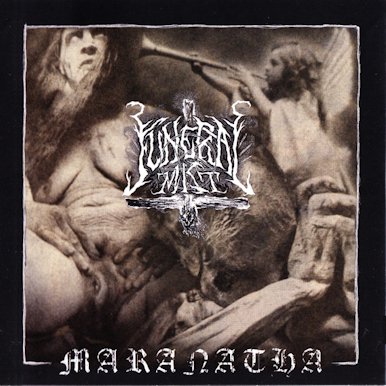
Release: 'Maranatha' (2009)

Mortuus/Arioch’s job of dragging Marduk from a state of apparent apathy back to black metal heavyweight status was no easy task. It seemed as if the band had become a parody of itself and disconcertingly, black metal; a succession of lacklustre, soulless releases told of nothing but sluggishness and a total lack of inspiration.

Inevitably, Arioch’s incorporation into the act breathed new life into its wearied lungs and powerful, serious material was subsequently vomited forth. Gone was the fist-fucking and pseudo-Nazi chic and in was medieval religious imagery and theistic Satanist overtones: the regular diet of Arioch’s endlessly impressive and seminal project, Funeral Mist.

Many fans of Funeral Mist may have feared that Arioch’s commitment to an act that tours as extensively as Marduk would sound the death knell for the project and 2003’s dizzying 'Salvation' looked set to be its swansong and magnum opus, a label it already deserved from the moment it was put to physical format, either way. However, with the announcement of 'Maranatha', the prodigal return of Funeral Mist after at least six years of silence, eager audiences poised themselves to level criticism at a release that it was believed could never better, or even match, 'Salvation'.

From the outset, 'Maranatha' is thoroughly arresting and undeniably powerful material. Even more emphasis is placed on Arioch’s inimitable and honestly chilling vocal style: and ode to possession and incredible strain. Sections of songs and the clever use of samples, both choral and otherwise, are woven together seamlessly, particularly noticeable and used to devastating effect on the track, “A New Light”.

The music is complimented by striking artwork and visuals; the juxtaposition of sterile, benevolent Christian imagery, pornography mixed with emaciated torsos and hungry stares and the scrawled yet legible calligraphic style is almost palatable in its seemingly effortless potency. Again, like 'Salvation', 'Marantha' is lyrically faultless and arguably divinely inspired.

'Maranatha' allows the listener a little more room, a little more space to assimilate the still mostly chaotic proceedings but in doing so, loses that impenetrable molasses that made 'Salvation' so purely unhinged and memorable. Indeed, the injection of variety is a welcome one - there being slower, almost “dirge-y” tracks that offer something new, such as “White Stone”  - but this aspect could upset those who relished the “heads down” approach of its predecessor.

Though never fully managing to live up to the landmark status of 'Salvation', even in its most breathtaking moments, this release remains wholly impressive and clearly indicative of Arioch’s many talents.
This is contemporary black metal in one of its finest guises by an act that has spawned countless, and mostly inept, imitators. While Arioch has definitely brought credibility and longevity to Marduk, it is within Funeral Mist that he is obviously in his element.

Rating: 60%

-polymer

Wednesday, 19 October 2011

BOOK REVIEW: On the Road - Jack Kerouac

Frenzied, effervescent and peppered with his “spontaneous prose”, Kerouac’s On the Road is occasionally akin to the rickety, death trap motorcars in which the characters crisscross the American expanse.

Moments of profound insight reveal an ideal not far from that of Catcher in the Rye’s Holden Caulfield, albeit a little more drug-fuelled and carefree than Holden would possibly have ever allowed himself to be.

Kerouac’s road is one of life and life’s journey; travelled by all, well worn and eventually unveiling a universal epiphany, even if some fail to hearken to it or simply choose to ignore it.

While both an initially carefree journey of self-discovery and experimentation, in its most tender moments, On the Road is essentially a search for identity, an undeniably American pastime. Dean Moriarty’s search for his father reveals it also as a commentary on family, or the lack thereof, and the inherent challenges faced in either scenario. The novel is a search for family or the creation of your own; every human’s pursuit of happiness, or at least marketed notions of it.

Though touted as “life-changing”, it is possibly difficult for contemporary readers to fully appreciate the impact this classic made when first published. Nonetheless, once absorbed, its memory and accompanying experience is wholly indelible.

On the Road is yet another novel that promotes America and that American sense of adventure to the foreigner – a vastness of heat, wonder and endless possibility, a horizon that never will, and seemingly cannot, end.

It revels in an adventure and attitude we all wish to embrace, but the reality of such an approach to life overall comes crumbling down in its final farewell pages.

Sal Paradise, the tag-along, becomes its true protagonist, possessing just enough of the lost Dean Moriarty, the embodiment of Beat, but none of his inherent, irreparable flaws.

Originally posted to Shelfari.com, 1 June, 2010.

-polymer

BOOK REVIEW: The Road - Cormac McCarthy

Constantly dangling the American dream and the pioneering impulse that forged the country over a precipice, McCarthy shatters “the road” as a motif of adventure and escape and moulds it into an arena of constant threat and grotesque degradation.

Bleak, thoroughly affecting and yet utterly redemptive, The Road is a celebration of the indefatigable human spirit and driving will to survive; a juxtaposition of a burning hope in an utterly hopeless, burned world.

Originally posted to Shelfari.com, 16 May, 2010.

-polymer

BOOK REVIEW: 'Salem's Lot - Stephen King

A tome that plunges the reader into the all too shallow waters of childhood fears, small-town mentality and a world-feared legend, King’s ‘Salem’s Lot is an unnervingly effective and unforgettable horror opus.

The Lot’s vampires recall their true origins as plague carriers and unclean, unholy wandering wastes, to whom only will and faith holds the doors fastened.

Hastily-fashioned stakes, dusty crucifixes and cloves of garlic abound as the contemporary combats a menace medieval in its approach and cruelty.

King’s skill soaks through the pages as from a jagged wound bound in cloth, displaying his ability to plunge the reader into his created world by peeling away adult reason and forcing the imagination to once again witness the eyes that peer from the closet and to hear the rhythmic breathing from under the bed.

The Marsten House, perpetually looming and seemingly invincible, is a numbing representation of every old-wives' tale and local legend found the world over.

Simply excellent.

Originally posted to Shelfari.com, 3 May, 2010.

-polymer