Monday, 24 October 2011

Every Knee Shall Bow

Band: PESTKREUZ
Release: 'Perdition Discipline' (2010)

Jaded popular humour may often deride Canada as the United States of America's straight-laced, boring cousin, but in the arena of extreme music, Canada has no problem holding its head high.

Able to boast endlessly seminal acts such as Blasphemy, Conqueror and Revenge, the implacable Canadian zeal for sonic intensity is one many undergrounds worldwide could only ever wish for.

Deepening the footprints left by all too short-lived acts like Ouroboros, Rites of Thy Degringolade and currently 'on-hold' Gloria Diaboli, Pestkreuz have floated to the top of the often stagnant and derivative traditional/'orthodox' black metal murk.

'Perdition Discipline' is one of those incredibly comfortable and proficient self-released demos that boast the aroma of well-cooked concepts and unshakeable focus; this is a band and demo with an unnervingly tangible determination.

This offering's four tracks present a heady mixture of early Satyricon and 'Devilry'-era Funeral Mist, with just enough tempo variation mercifully avoiding breaking the flow of the release. Some sections may appear predictable, but there are a sufficient number of unfolding melodies throughout the demo that work to keep the listener engaged. Typically frenzied, yet creative and interesting, tremolo picking abounds, weaving in and out of consistently strong percussion and an impressive, decipherable vocal performance.

Declarations such as, "Pestkreuz exists solely to spread the Gospel of Plague ... [to] shake the uninitiated from their cosmic illusions, and elevate the adept towards the fruits of Gnosis", may seem commonplace to contemporary black metal followers, but Pestkreuz succeed in bounding over that cusp that leaves a lot of black metal in the lamentable realm of sincerity versus self-parody.

Suitably dark, religious imagery has been deftly manipulated and inverted for the release's accompanying artwork; a ghoul-like Christ bids us follow him into damnation, a hangman's noose draped over each open palm, as winged serpents adorn the cornices.

Though but a morsel compared to the feast that Pestkreuz would surely offer on a full-length release, 'Perdition Discipline' is a fresh and arresting presentation of black metal, one that adheres to the genre's sensibilities and traditions but also adds fuel to its sardonic existence.

Rating: 70%

Also submitted to metal-archives.com under the username 'torchia', 24 October, 2011.

-polymer

Thursday, 20 October 2011

Jesus Saves

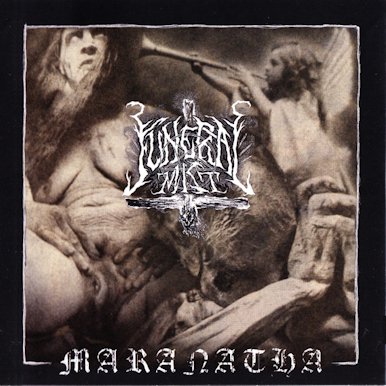
Band: FUNERAL MIST
Release: 'Maranatha' (2009)

Mortuus/Arioch’s job of dragging Marduk from a state of apparent apathy back to black metal heavyweight status was no easy task. It seemed as if the band had become a parody of itself and disconcertingly, black metal; a succession of lacklustre, soulless releases told of nothing but sluggishness and a total lack of inspiration.

Inevitably, Arioch’s incorporation into the act breathed new life into its wearied lungs and powerful, serious material was subsequently vomited forth. Gone was the fist-fucking and pseudo-Nazi chic and in was medieval religious imagery and theistic Satanist overtones: the regular diet of Arioch’s endlessly impressive and seminal project, Funeral Mist.

Many fans of Funeral Mist may have feared that Arioch’s commitment to an act that tours as extensively as Marduk would sound the death knell for the project and 2003’s dizzying 'Salvation' looked set to be its swansong and magnum opus, a label it already deserved from the moment it was put to physical format, either way. However, with the announcement of 'Maranatha', the prodigal return of Funeral Mist after at least six years of silence, eager audiences poised themselves to level criticism at a release that it was believed could never better, or even match, 'Salvation'.

From the outset, 'Maranatha' is thoroughly arresting and undeniably powerful material. Even more emphasis is placed on Arioch’s inimitable and honestly chilling vocal style: and ode to possession and incredible strain. Sections of songs and the clever use of samples, both choral and otherwise, are woven together seamlessly, particularly noticeable and used to devastating effect on the track, “A New Light”.

The music is complimented by striking artwork and visuals; the juxtaposition of sterile, benevolent Christian imagery, pornography mixed with emaciated torsos and hungry stares and the scrawled yet legible calligraphic style is almost palatable in its seemingly effortless potency. Again, like 'Salvation', 'Marantha' is lyrically faultless and arguably divinely inspired.

'Maranatha' allows the listener a little more room, a little more space to assimilate the still mostly chaotic proceedings but in doing so, loses that impenetrable molasses that made 'Salvation' so purely unhinged and memorable. Indeed, the injection of variety is a welcome one - there being slower, almost “dirge-y” tracks that offer something new, such as “White Stone”  - but this aspect could upset those who relished the “heads down” approach of its predecessor.

Though never fully managing to live up to the landmark status of 'Salvation', even in its most breathtaking moments, this release remains wholly impressive and clearly indicative of Arioch’s many talents.
This is contemporary black metal in one of its finest guises by an act that has spawned countless, and mostly inept, imitators. While Arioch has definitely brought credibility and longevity to Marduk, it is within Funeral Mist that he is obviously in his element.

Rating: 60%

-polymer

Wednesday, 19 October 2011

BOOK REVIEW: On the Road - Jack Kerouac

Frenzied, effervescent and peppered with his “spontaneous prose”, Kerouac’s On the Road is occasionally akin to the rickety, death trap motorcars in which the characters crisscross the American expanse.

Moments of profound insight reveal an ideal not far from that of Catcher in the Rye’s Holden Caulfield, albeit a little more drug-fuelled and carefree than Holden would possibly have ever allowed himself to be.

Kerouac’s road is one of life and life’s journey; travelled by all, well worn and eventually unveiling a universal epiphany, even if some fail to hearken to it or simply choose to ignore it.

While both an initially carefree journey of self-discovery and experimentation, in its most tender moments, On the Road is essentially a search for identity, an undeniably American pastime. Dean Moriarty’s search for his father reveals it also as a commentary on family, or the lack thereof, and the inherent challenges faced in either scenario. The novel is a search for family or the creation of your own; every human’s pursuit of happiness, or at least marketed notions of it.

Though touted as “life-changing”, it is possibly difficult for contemporary readers to fully appreciate the impact this classic made when first published. Nonetheless, once absorbed, its memory and accompanying experience is wholly indelible.

On the Road is yet another novel that promotes America and that American sense of adventure to the foreigner – a vastness of heat, wonder and endless possibility, a horizon that never will, and seemingly cannot, end.

It revels in an adventure and attitude we all wish to embrace, but the reality of such an approach to life overall comes crumbling down in its final farewell pages.

Sal Paradise, the tag-along, becomes its true protagonist, possessing just enough of the lost Dean Moriarty, the embodiment of Beat, but none of his inherent, irreparable flaws.

Originally posted to Shelfari.com, 1 June, 2010.

-polymer

BOOK REVIEW: The Road - Cormac McCarthy

Constantly dangling the American dream and the pioneering impulse that forged the country over a precipice, McCarthy shatters “the road” as a motif of adventure and escape and moulds it into an arena of constant threat and grotesque degradation.

Bleak, thoroughly affecting and yet utterly redemptive, The Road is a celebration of the indefatigable human spirit and driving will to survive; a juxtaposition of a burning hope in an utterly hopeless, burned world.

Originally posted to Shelfari.com, 16 May, 2010.

-polymer

BOOK REVIEW: 'Salem's Lot - Stephen King

A tome that plunges the reader into the all too shallow waters of childhood fears, small-town mentality and a world-feared legend, King’s ‘Salem’s Lot is an unnervingly effective and unforgettable horror opus.

The Lot’s vampires recall their true origins as plague carriers and unclean, unholy wandering wastes, to whom only will and faith holds the doors fastened.

Hastily-fashioned stakes, dusty crucifixes and cloves of garlic abound as the contemporary combats a menace medieval in its approach and cruelty.

King’s skill soaks through the pages as from a jagged wound bound in cloth, displaying his ability to plunge the reader into his created world by peeling away adult reason and forcing the imagination to once again witness the eyes that peer from the closet and to hear the rhythmic breathing from under the bed.

The Marsten House, perpetually looming and seemingly invincible, is a numbing representation of every old-wives' tale and local legend found the world over.

Simply excellent.

Originally posted to Shelfari.com, 3 May, 2010.

-polymer

A Reich Without End?

Band: KATHARSIS
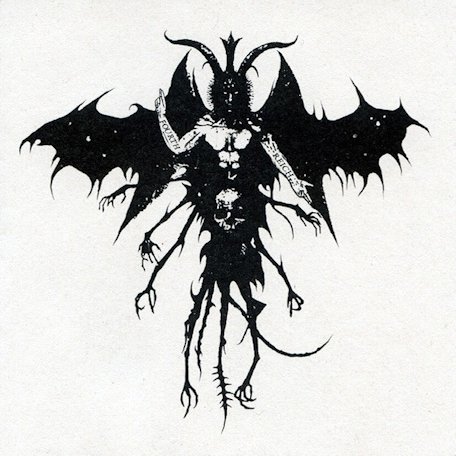
Release: 'Fourth Reich' (2009)

Having possibly the most unique sound among their illustrious label mates, Katharsis releases, especially since 2006’s monstrous 'VVorld VVithout End', are guaranteed to generate conversation, divide critics and not least of all, be snapped up promptly by fanatics.

Despite a shaky and maybe ill-chosen title, 'Fourth Reich' does deliver the band’s brand of typically cavernous, delay-drenched, raw and pounding black metal. Though some of that trademark claustrophobia has been loosened for this release, giving the instruments more space to breathe and allowing more variation as a result, unrelenting primitivism free of any production embellishments abounds plentifully.

The overall track structure and approach is more ambitious on this album; a great and strangely fitting guitar solo (by D. of Pagan BM outfit, Orlog) graces the final track, “Sinn Koronation”. More than ever, Katharsis appear a confident act fully aware of their talents and effortlessly display a rare mastery of the inherent hypnosis that is black metal’s atmosphere.

On 'Fourth Reich' material ranges from a mostly blast beat-filled attack to the odd mid-tempo section, the latter being, on this occasion, thankfully seldom, ensuring Katharsis stay as cacophonous as ever, albeit a little less oppressive sonically. There is nothing groundbreaking here, but this is black metal written and executed very well with moments of melodious surprise. However, an instrumental track, “Emeralde Graves”, found between the third and fourth tracks succeeds only in ruining the flow of the album and its ever-building atmosphere and could well have been omitted.

Much like Funeral Mist’s recent 'Maranatha', 'Fourth Reich' had a lot to live up to: a well-fed and by now, headstrong predecessor whose notoriety verges on “landmark album” status, not just for the band concerned but for the genre of black metal itself.
Nonetheless, 'Fourth Reich' remains a solid addition to Katharsis’s catalogue, but one that will forever tug at the robe tails of 'VVorld VVithout End'.

Rating: 70%

Originally uploaded under the username 'torchia' to metal-archives.com, 9 June, 2009.

-polymer

A Guiding Light From a Black Flame

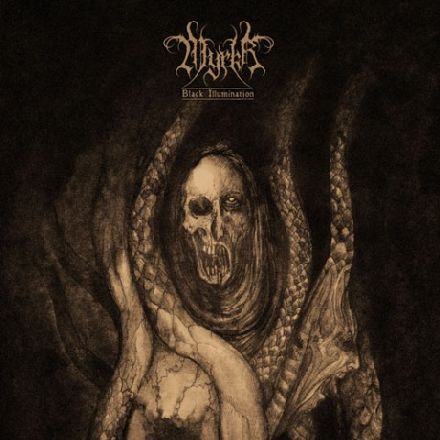
Band: MYRKR
Release: 'Black Illumination' (2009)

Ireland’s black metal output is interesting to watch, and due to the currently limited number of quality acts, thankfully easy to follow. However, it is perhaps disappointing that Ireland may never boast the level of quality black metal output that the likes of Sweden can muster.

One could argue that this is due to population, geography and/or the country’s affinity with the genre but, rather, it seems due to attitude, or a lack thereof. Despite Ireland’s bloody and definitely miserable history, coupled with a generally depressive, alcoholic air, its metal ilk seem to have never unanimously embraced real black metal.

Though far from unknown, Myrkr strikes sporadically from the greatest depths of Ireland’s “underground” and continuously levels audiences with a quality matched only by the intentionally reclusive Rebirth of Nefast, whose mastermind, Wann, lends his vocal talents to 'Black Illumination'. Wann adds an element of the unreal to Myrkr, giving some songs an almost ecclesiastical quality and teases with possible hints at the majesty that would dominate a Rebirth of Nefast full-length when one is finally seen.

Extensive (but never excessive) layering sees the upfront, cold sound of previous recordings pushed back slightly, allowing the album to comfortably tinker with dense and murky atmospherics. Even further under this blanket of twisting soundscapes, haunting chants and choral work are just audible, more evidence of Wann’s input and indelible mark on this fine recording.

Myrkr’s Gast is enviably comfortable behind a multitude of instruments and improves with every wave of a plectrum or snap of a drum kit. Most notable here is the ever-improving percussion which possesses a fitting “stripped-back” or essential approach, adding to the album’s tangible sense of decay and desperation, a constant clawing at dark, invisible, slick walls. ‘Black Illumination’ presents an endless sense of the ominous, a constantly flowing, almost ocean-like lulling sound with a truly hypnotic quality. It is introspective, knowingly obscure and a challenging and intricate listen; a magnum opus in every sense.

Far from simply an Irish black metal essential, it is plainly essential. Myrkr’s output is a paean to passion and an appreciation of black metal that resolutely goes above and beyond the call of duty time and time again. When 'Black Illumination' ceases, there is a feeling of an other-worldly experience cut short, a journey to ebony realms abruptly terminated.

Rating: 90%

Originally uploaded under the username 'torchia' to metal-archives.com, 13 September, 2009.

-polymer